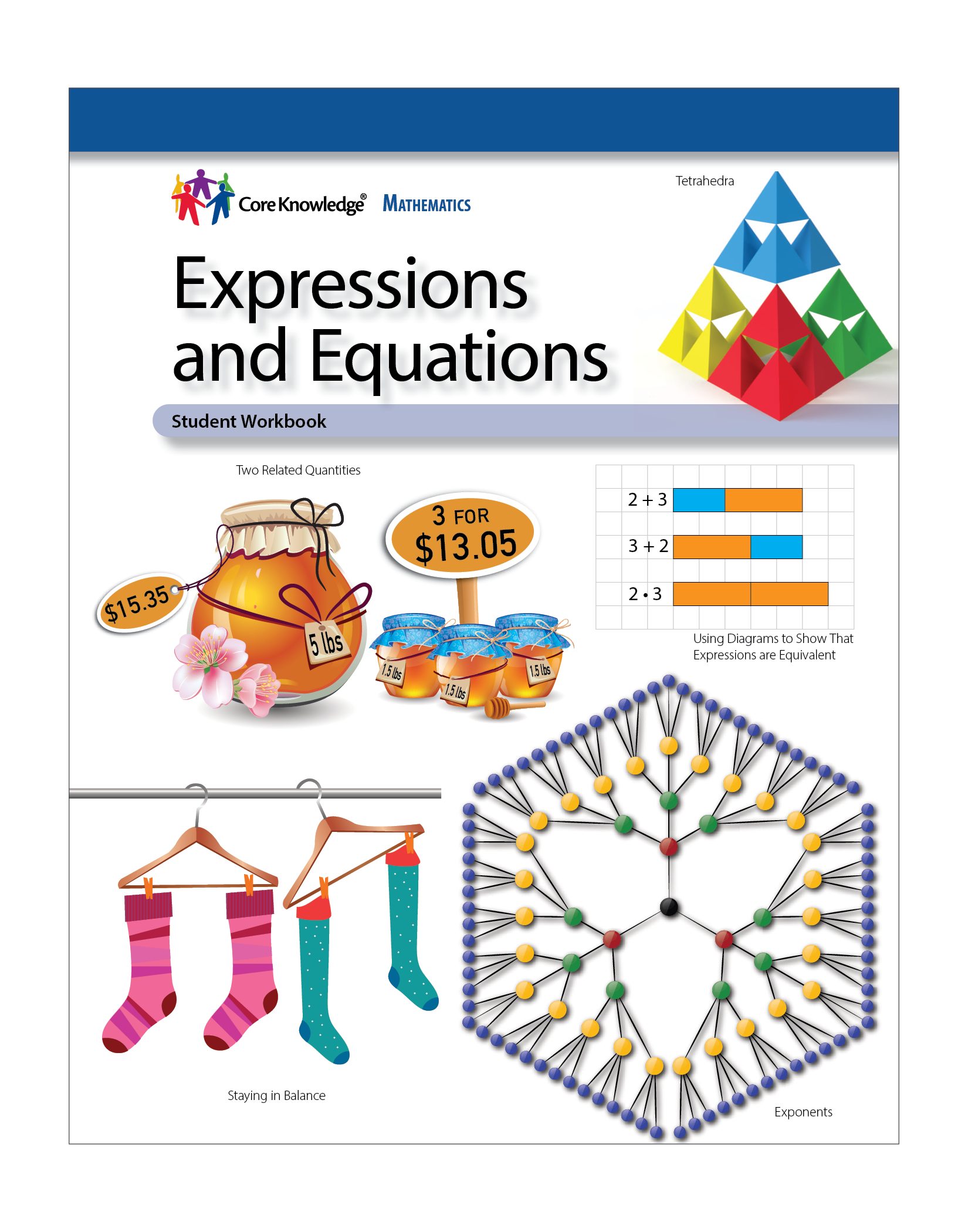
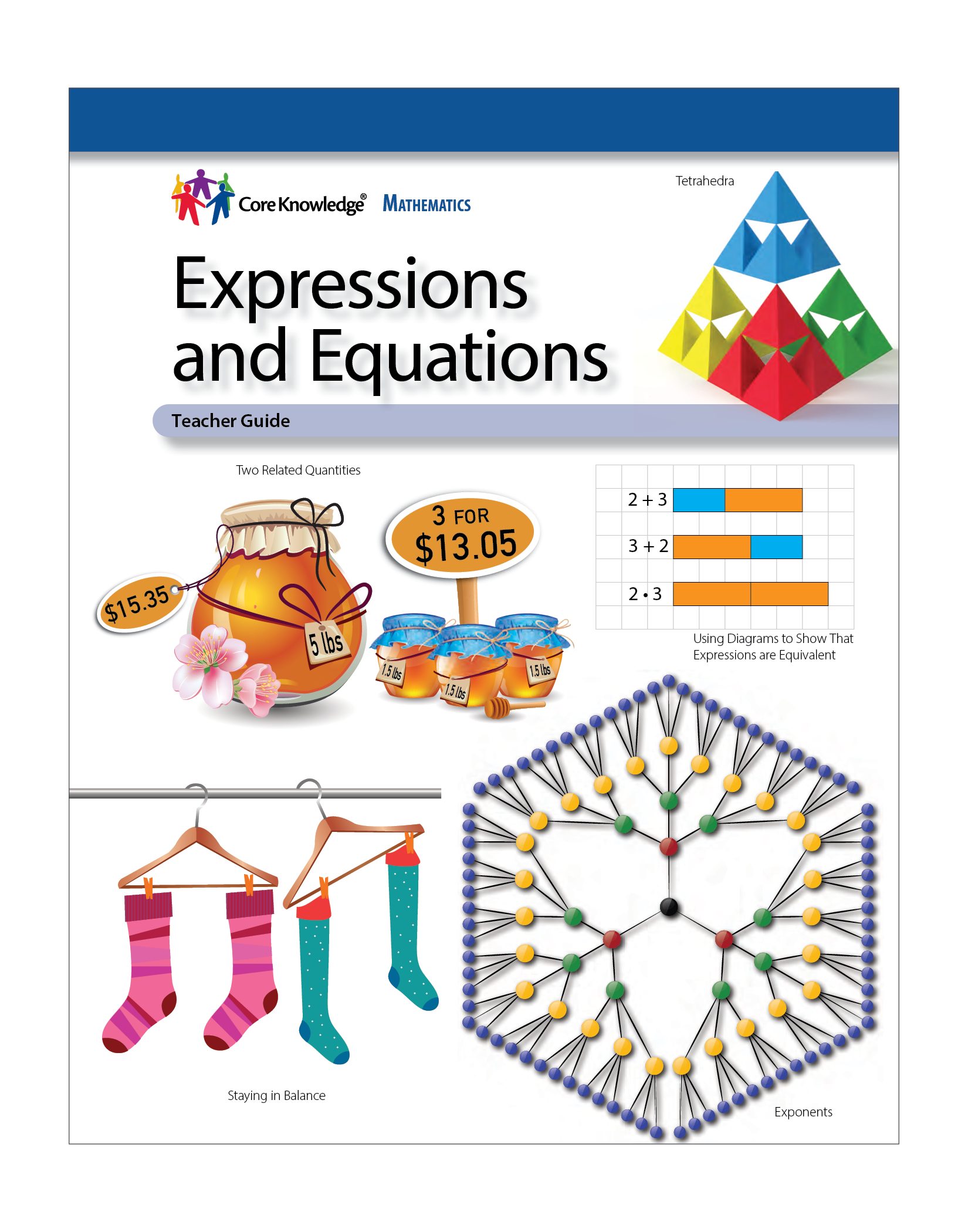
CKMath Unit 6: Expressions and Equations
Focus:
Students begin the unit by working with linear equations that have single occurrences of one variable. They represent relationships with tape diagrams and with linear equations, explaining correspondences between these representations. They examine values that make a given linear equation true or false, and what it means for a number to be a solution to an equation. Solving equations of the form px=q where p and q are rational numbers can produce complex fractions (i.e., quotients of fractions), so students extend their understanding of fractions to include those with numerators and denominators that are not whole numbers.
The second section introduces balanced and unbalanced “hanger diagrams” as a way to reason about solving the linear equations of the first section. Students write linear equations to represent situations, including situations with percentages, solve the equations, and interpret the solutions in the original contexts, specifying units of measurement when appropriate. They represent linear expressions with tape diagrams and use the diagrams to identify values of variables for which two linear expressions are equal. Students write linear expressions such as 6w – 24 and 6(w – 4) and represent them with area diagrams, noting the connection with the distributive property. They use the distributive property to write equivalent expressions.
In the third section of the unit, students write expressions with whole-number exponents and whole-number, fraction, or variable bases. They evaluate such expressions, using properties of exponents strategically. They understand that a solution to an equation in one variable is a number that makes the equation true when the number is substituted for all instances of the variable. They represent algebraic expressions and equations in order to solve problems. They determine whether pairs of numerical exponential expressions are equivalent and explain their reasoning. By examining a list of values, they find solutions for simple exponential equations of the form
a = bx, e.g., 2x = 32, and simple quadratic and cubic equations, e.g., 64 = x3.
In the last section of the unit, students represent collections of equivalent ratios as equations. They use and make connections between tables, graphs, and linear equations that represent the same relationships.
Number of Lessons: 17 and 2 optional
Instruction Time:
Approximately 50 minutes
(Please note that each lesson is designed for one instructional block, and may be divided into shorter or longer segments based on teacher pacing and student needs.)