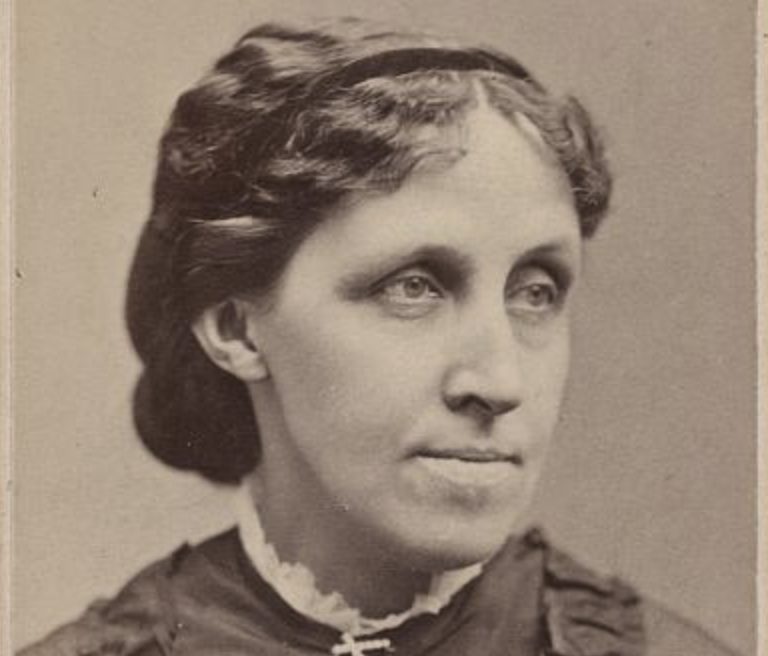
Our interviewer, Sophie Nunnally, is Associate Managing Editor for The Core Knowledge Free Library. Louisa May Alcott was an American novelist best known for writing Little Women, one of the most enduring works of children’s and young adult literature and available in CKLA Grade 5.
Sophie Nunnally: Ms. Alcott, it’s a pleasure to meet you. Thank you so much for being here today. I know you don’t relish the limelight.
Louisa May Alcott: Please, call me Louisa. And it’s true, I prefer writing in the quiet of my own home to attending public engagements.
SN: I imagine you have had to deal with quite a bit of fame since the publication of Little Women. I heard you once declined a speaking engagement only to be asked to sit on a rotating stage for readers to simply look at you. Is that true?
LMA: Ah, unfortunately, yes. You see, my father was more the family orator than I.
SN: How so?
LMA: Well, he was a teacher, for one—and a passionate one. He had strong beliefs about how children should learn: critical thinking, open discussion, analysis, and all of that. Many did not agree with him. He was quite the radical.
SN: It’s hard to imagine not agreeing with those teaching methods. I imagine you and your sisters benefited from his approach to education, then?
LMA: Without a doubt. He taught my sisters and I everything he knew. But he didn’t make very much money from teaching, and even less when his schools were shut down for his beliefs. We were often so poor that we had to work instead of going to school. But we always found a way to continue our learning at home.
SN: How ironic that such an avid teacher couldn’t afford to keep his own children in school. How was that experience for you?
LMA: I can’t deny that there were many difficult years. We were too often ill, poor, unhappy, and divided. But there were bright spots, too, at Hillside and Orchard House, with my mother and sisters.
SN: I’m glad to hear it. But how did you manage that instability at such a young age? Did you ever want to escape?
LMA: Well, I couldn’t very well abandon my family, but I had to stay sane somehow. So, I wrote. It may sound strange, but I would fall into what I called a “vortex,” in which nothing else mattered but pen, paper, and plot. Sometimes I would remain in that “world” for weeks.
SN: Goodness! Where did you go? What did you write about?
LMA: Wherever and whatever I could dream up! Far off places, dramatic romances, daring heroes!
SN: How exciting! It sounds like you have quite the imagination.
LMA: One could certainly say that!
SN: But I must say, those kinds of stories sound nothing like the tale that unfolded in Little Women.
LMA: Yes, I was surprised to find that the revelations about my own life resonated more with readers.
SN: Did you ever imagine the impact your writing would have?
LMA: I can’t say that I imagined fame for myself, nor can I claim that it was it ever something I hoped for. Rather, I always hoped that I would one day make enough money to lift my family out of poverty.
SN: What are some of the lessons readers learned from reading Little Women?
LMA: When I decided to write the book, I wanted to write about what I knew. In the end, my success was born of my family—our struggles, our perseverance, and above all, the love between four sisters and their mother. I made my family’s dream come true by sharing precious parts of them with the world. I can only hope my readers learned from those.
SN: Do you believe readers saw themselves in the real stories you shared from your own life? Is that what resonated?
LMA: Yes, but that’s not all. As I was explaining before, imagination is what got me through the dark times. You’ve probably realized by now that the life I created for the characters of Little Women was not identical to my life. As I was writing about my family, I dared to dream of a better life for us—and I put that imagined life on the page, too. I think that is what ultimately resonated with so many readers: marrying the real with the imagined. Little Women presented a life they recognized—the bickering siblings, having to go without, an absent parent, the loss of a loved one—but with small, meaningful pieces of perfection woven in they could hold onto and dream of. I think we all deserve to dream.
SN: I can’t say that I disagree with you there. It sounds like you value imagination immensely. What would you say to young readers today who don’t explore their imagination?
LMA: I would present them with a word of caution: you are only limiting yourself. One’s world shrinks when one does not know what might be out there. Read about someone else’s life and circumstance—real or fictional—and one will start to scratch the surface of what is possible. For me, that was saving my entire family from poverty, and myself from a life of hardship and sadness. All that came from imagining—from dreaming.
SN: Well, I would say that is just about the most beautiful note we could end this interview on. Ms. Alcott—pardon me—Louisa, thank you for sharing a bit of your imagination with us!
LMA: With pleasure. And my deepest thanks to you for not asking to conduct this interview live.
SN: I wouldn’t dream of it.