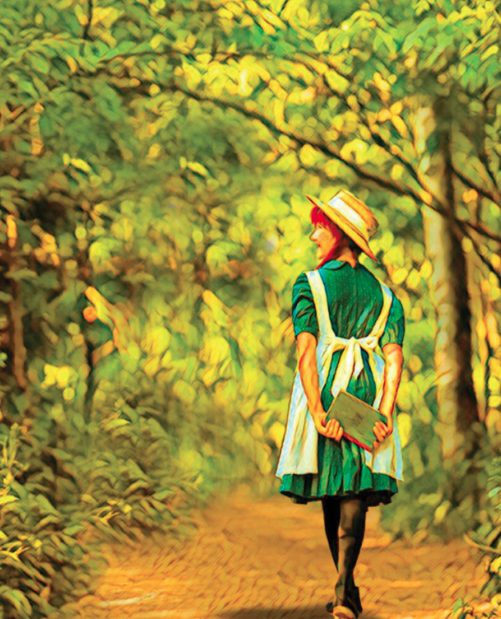
Our interviewer, Erin Wasserman, is Associate Production Manager at the Core Knowledge Foundation, where she coordinates the production of curriculum materials and digital resources. Anne Shirley, better known as Anne of Green Gables is one of the beloved characters featured in the Core Classics Series, available here.
Erin: Anne, thank you so much for joining me today! Before we get started, can you please introduce yourself to our readers? Who exactly is Anne Shirley, where do you come from, and how did you become such a literary legend?
Anne: A literary legend! Oh, my! I do quite love the sound of that. My name is Anne Shirley, with an “E”, very important, please don’t forget that. And I come from Avonlea, on Prince Edward Island, Canada. I arrived at Green Gables as an orphan after Matthew and Marilla Cuthbert intended to adopt a boy. There was a rather large misunderstanding there, but don’t worry, it all worked out in the end.
Erin: Definitely! More than a century later, people are still reading about your adventures. Why do you think you’ve made such a lasting impression?
Anne: Perhaps because I’ve made so many mistakes! Mistakes make much more entertaining stories than perfection. But I’d like to think people remember my imagination, too. I’ve always thought the world becomes much more interesting when you refuse to see it only as it is.
Erin: That leads me very nicely into what I wanted to ask you. A question that may seem super simple …until you try and answer it: Why read?
Anne: Oh, Erin, you’re right. What a hard question! That’s like asking why we should have an imagination, or raspberry cordial, or friends. Life would be so incredibly boring without them.
Erin: So, you think we read to make life enjoyable?
Anne: It certainly does helps. But it is truly more than that, must everything have a lesson attached to it?
Erin: Oh no…I think you may have made some educators nervous. Shall we pivot?
Anne: No. I just think that perhaps they aren’t reading a good enough book.
Erin: That’s fair. But we’re constantly asking what children should get from reading. Whether that be vocabulary, or comprehension, or gaining background knowledge, and learning critical thinking skills. Surely those matter? Right?
Anne: Of course they matter! But I think you’re putting the cart before the horse, as they say. I don’t love stories because they improve my vocabulary. My vocabulary improvs because I love stories.
Erin: I love that! What an important difference.
Anne: When you read about a place you’ve never been, you begin wondering what it looks like. Then perhaps you want to know where it is, and then maybe one day you’ll travel there! Or in a different story, you might meet a person who lived a hundred years ago, and suddenly you want to know what people wore then, what they ate, what they believed, and why they behaved in such odd ways. Stories can change your trajectory completely.
Erin: I think you may have just described background knowledge.
Anne: Did I? That doesn’t sound nearly as romantic as traveling the world or meeting someone from a whole century ago.
Erin: That is the magic of reading, but in a nutshell, yes. The more you know, the more you’re able to understand when you encounter something new, and the more you can make future decisions based on that.
Anne: Precisely! Although I think it sounds better to say, the more you know, the more there is to wonder about.
Erin: I do like yours better.
Anne: But of course.
Erin: There’s also a growing concern that children are reading less for fun and only for obligation. If you could speak directly to a child who says, “I don’t like reading,” what would you tell them?
Anne: I would ask what they’ve been given to read.
Erin: And…? That’s it?
Anne: Well, I might give a speech. I do have a tendency toward speeches.
Erin: So I’ve heard.
Anne: But I wouldn’t say that someone dislikes reading simply because they haven’t yet found something they desperately want to read. Perhaps they haven’t met the right story. Or the right person in a story.
Erin: So how do we help children find that?
Anne: Give them an opportunity to know about wonderful things to know! Heroes and villains and faraway places. Oceans and stars and ancient civilizations. Give them people who made terrible mistakes and people who did extraordinarily brave things. And don’t tell them beforehand exactly what they’re supposed to think about all of it.
Erin: Why not?
Anne: Because wondering and then figuring it out yourself is half the fun.
Erin: One last question for you. Can you finish this sentence for me? Children should read because…
Anne: Because the world indeed stretches far beyond what you can see from where you stand, and reading turns the page the rest of it.
Erin: That’s pretty poetic of you.
Anne: I can be poetic, I love poetry! Come, I’ll share some with you.
Erin: Sure!
Anne: Oh and please do make sure you credit this to Anne with an “E” please, it’s very important.