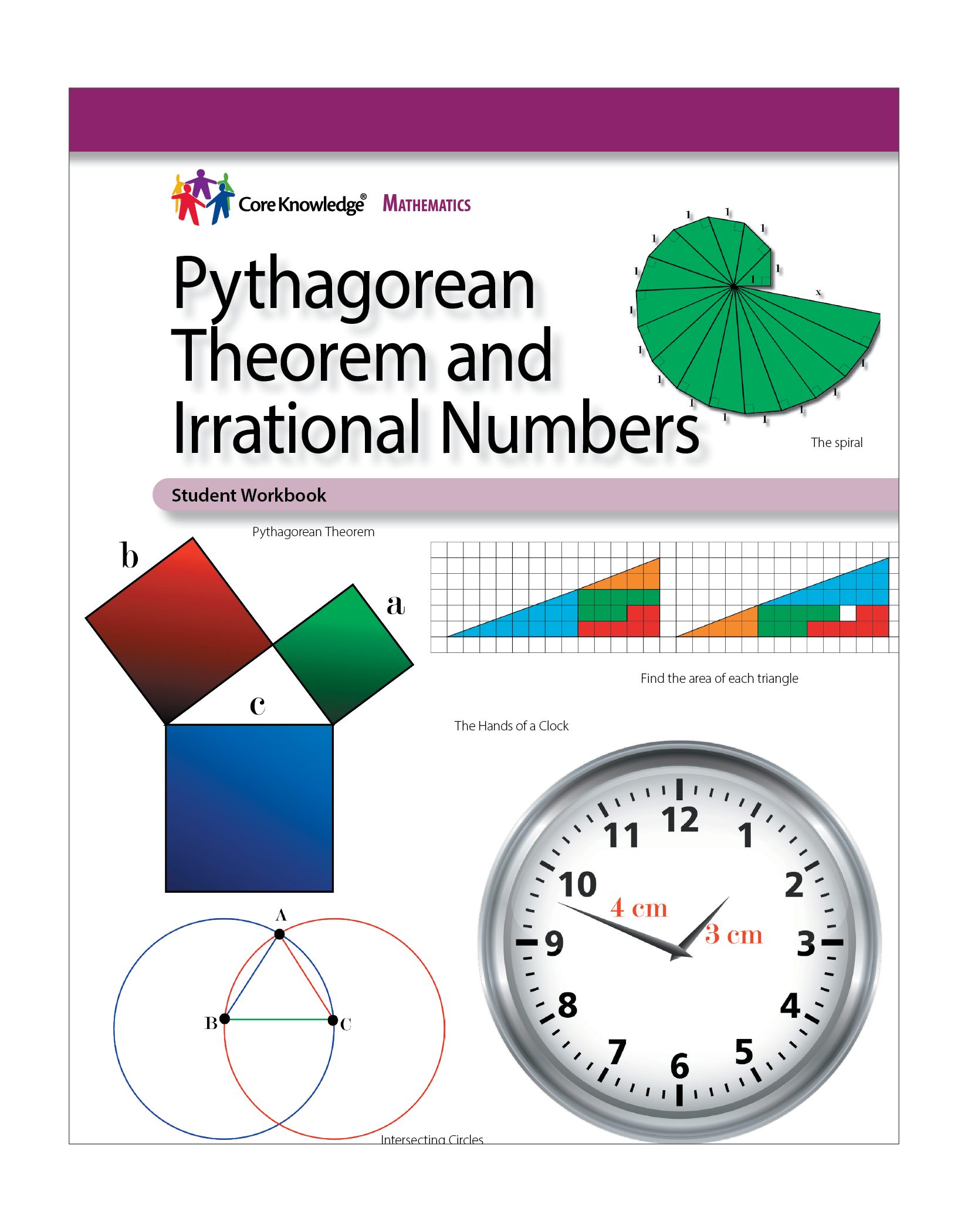
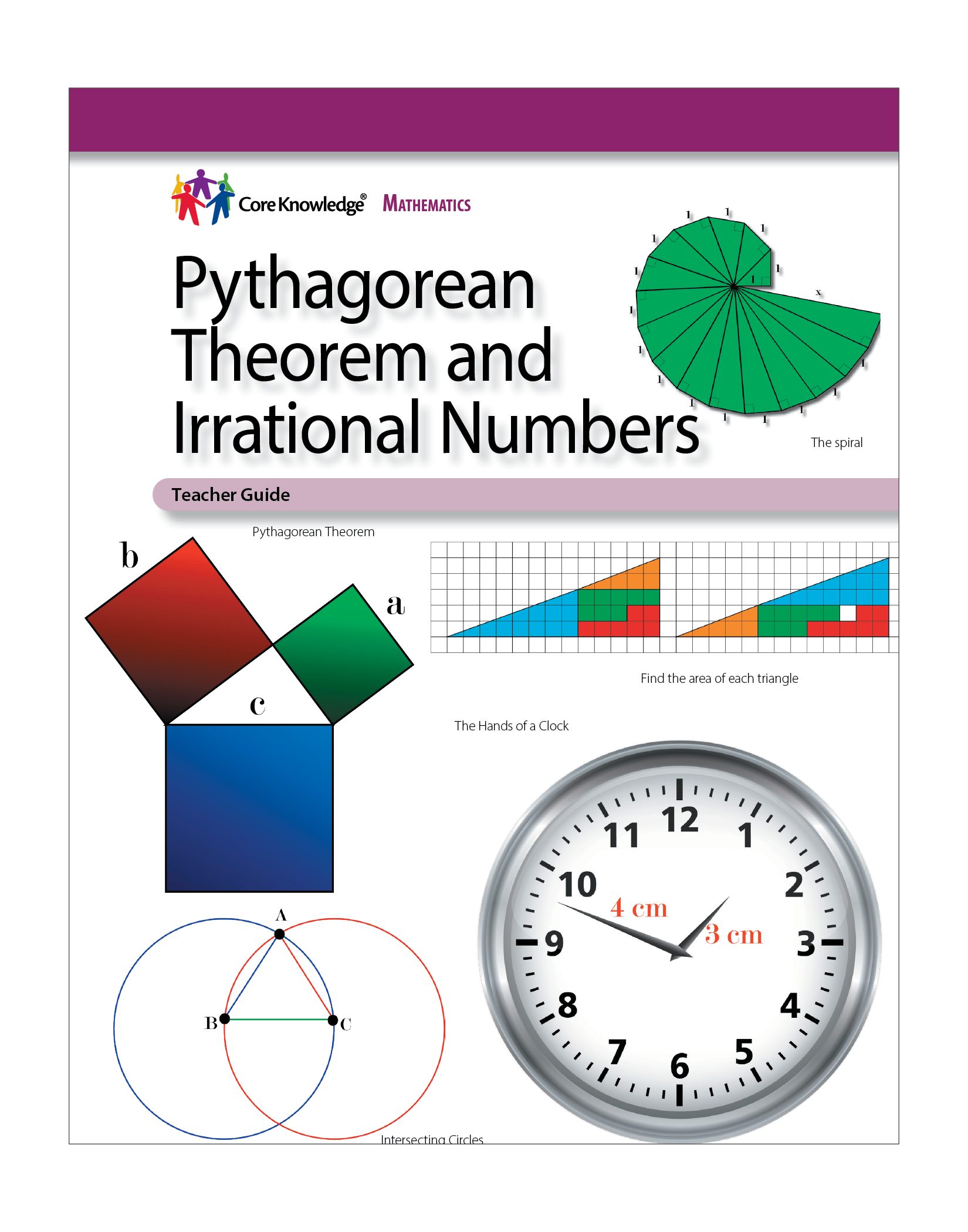
CKMath Unit 8: Pythagorean Theorem and Irrational Numbers
Focus:
Work in this unit is designed to build on and connect students’ understanding of geometry and numerical expressions. The unit begins by foreshadowing algebraic and geometric aspects of the Pythagorean Theorem and strategies for proving it. Students are shown three squares and asked to compare the area of the largest square with the sum of the areas of the other two squares. The comparison can be done by counting grid squares and comparing the counts—when the three squares are on a grid with their sides on grid lines and vertices on intersections of grid lines—using the understanding of area measurement established in grade 3. The comparison can also be done by showing that there is a shape that can be decomposed and rearranged to form the largest square or the two smallest squares. Students are provided with opportunities to use and discuss both strategies.
In the second section, students work with figures shown on grids, using the grids to estimate lengths and areas in terms of grid units, e.g., estimating the side lengths of a square, squaring their estimates, and comparing them with estimates made by counting grid squares. The term “square root” is introduced as a way to describe the relationship between the side length and area of a square (measured in units and square units, respectively), along with the notation √. Students continue to work with side lengths and areas of squares. They learn and use definitions for “rational number” and “irrational number.” They understand two proofs of the Pythagorean Theorem—an algebraic proof that involves manipulation of two expressions for the same area and a geometric proof that involves decomposing and rearranging two squares. They use the Pythagorean Theorem in two and three dimensions, e.g., to determine lengths of diagonals of rectangles and right rectangular prisms and to estimate distances between points in the coordinate plane.
In the third section, students work with edge lengths and volumes of cubes and other rectangular prisms. (In this grade, all prisms are right prisms.) They are introduced to the term “cube root” and the notation √3. They plot square and cube roots on the number line, using the meanings of “square root” and “cube root.
In the fourth section, students work with decimal representations of rational numbers and decimal approximations of irrational numbers. In grade 7, they used long division in order to write fractions as decimals and learned that such decimals either repeat or terminate. They build on their understanding of decimals to make successive decimal approximations of 2–√ and π which they plot on number lines.
Number of Lessons: 16
Instruction Time:
Approximately 60 minutes
(Please note that each lesson is designed for one instructional block, and may be divided into shorter or longer segments based on teacher pacing and student needs.)