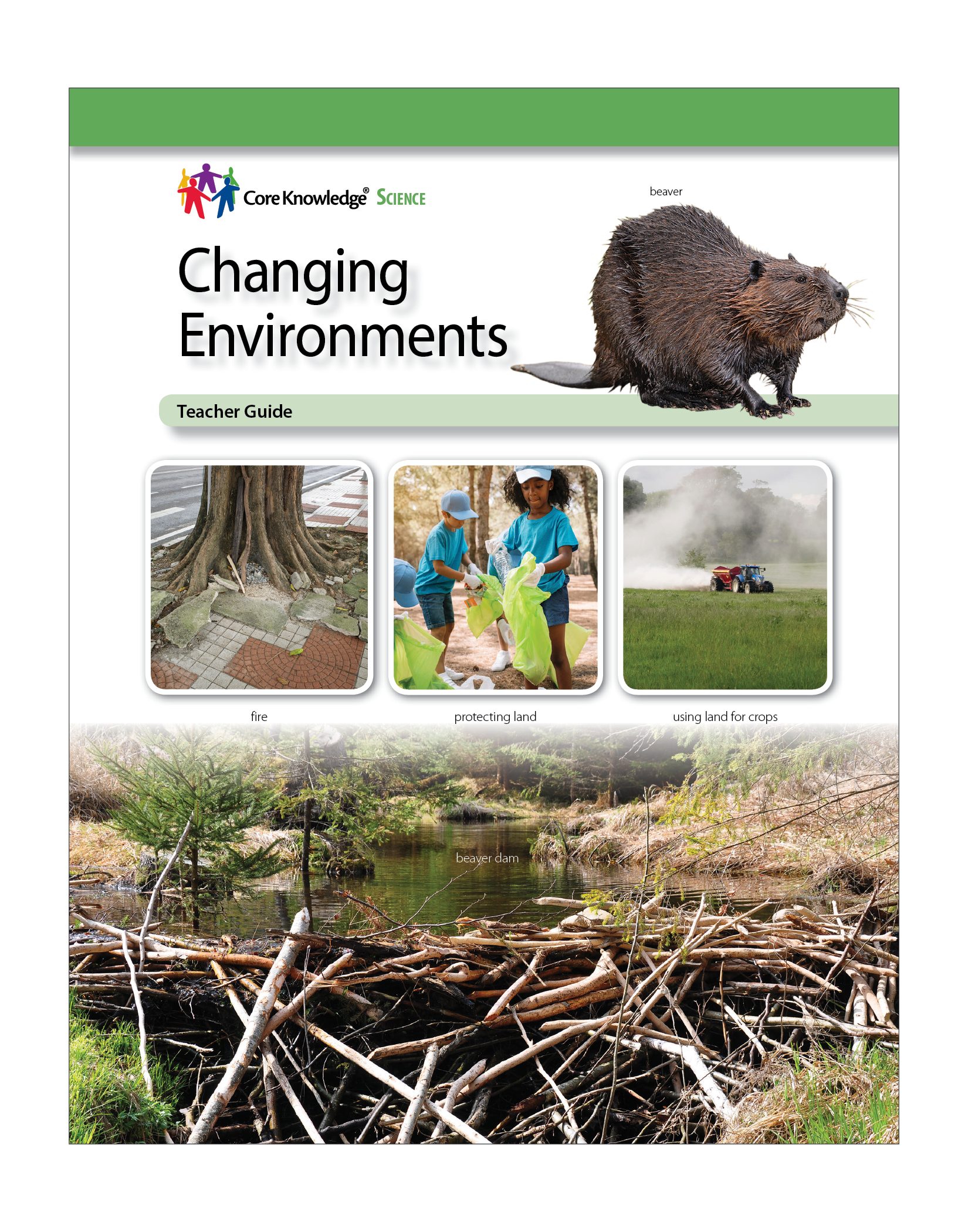
CKSci Unit 3: Changing Environments
Focus:
Plants and animals, including humans, have vital needs that must be met for the organism to live and grow. All living things need water and air. Plants also need light, mineral nutrients, and space to grow. Animals, including humans, need food and shelter, which is mostly derived from plants. In getting what they need, plants and animals change their environments.
In this unit, the guiding phenomenon is an examination of the before-and-after stories of the effects of living things on the environment to see how the environment is changed. The unit builds on Unit 2, in which students explored the needs of plants and animals (PE K-LS1-1 and K-ESS3.1). In Grade one, students will develop understanding of plant and animal survival, and in Grade two, students will explore organisms and their habitats more deeply.
Students explore concepts that include the following:
- Organisms get what they need from the environment.
- Damaging environmental changes can affect organisms.
- Environmental changes affect the needs of plants, animals, and humans.
- There is evidence of plants, animals, and humans causing changes to an environment.
- There are both negative and positive ways in which humans impact the environment.
- There are practical ways to protect the environment.
Scientists, including biologists, zoologists, geologists, and climatologists, study how living things affect the land, air, and water. This series of lessons incorporates learning goals that support scientific principles and practices, such as asking questions, arguing with evidence, analyzing and interpreting data, recognizing cause and effect, and planning and carrying out investigations.
Number of Lessons: 5 (Each lesson is divided into four to five lesson segments.)
Instruction Time:
- Each Lesson may be divided into Lesson Segments.
- Each Lesson Segment is designed to be completed in one 30–45-minute class period.
- Some single-day activities and performance tasks might require setting aside a longer block of time.
- This Unit should be completed between 24–37 classroom days.
- A Pacing Guide Template is provided within the Teacher Guide so teachers can map out customized instructional days for this unit.
- A complete list of Materials needed to complete the unit is provided in Online Resources.
Additional Search Terms:
animal needs • plant needs • seasons • environment • fire • drought • flood • sunlight • living space • shelter • conserve • pollution • recycle • reduce • reuse • ecosystem • eco-friendly • soil scientist • nonfiction • informational text