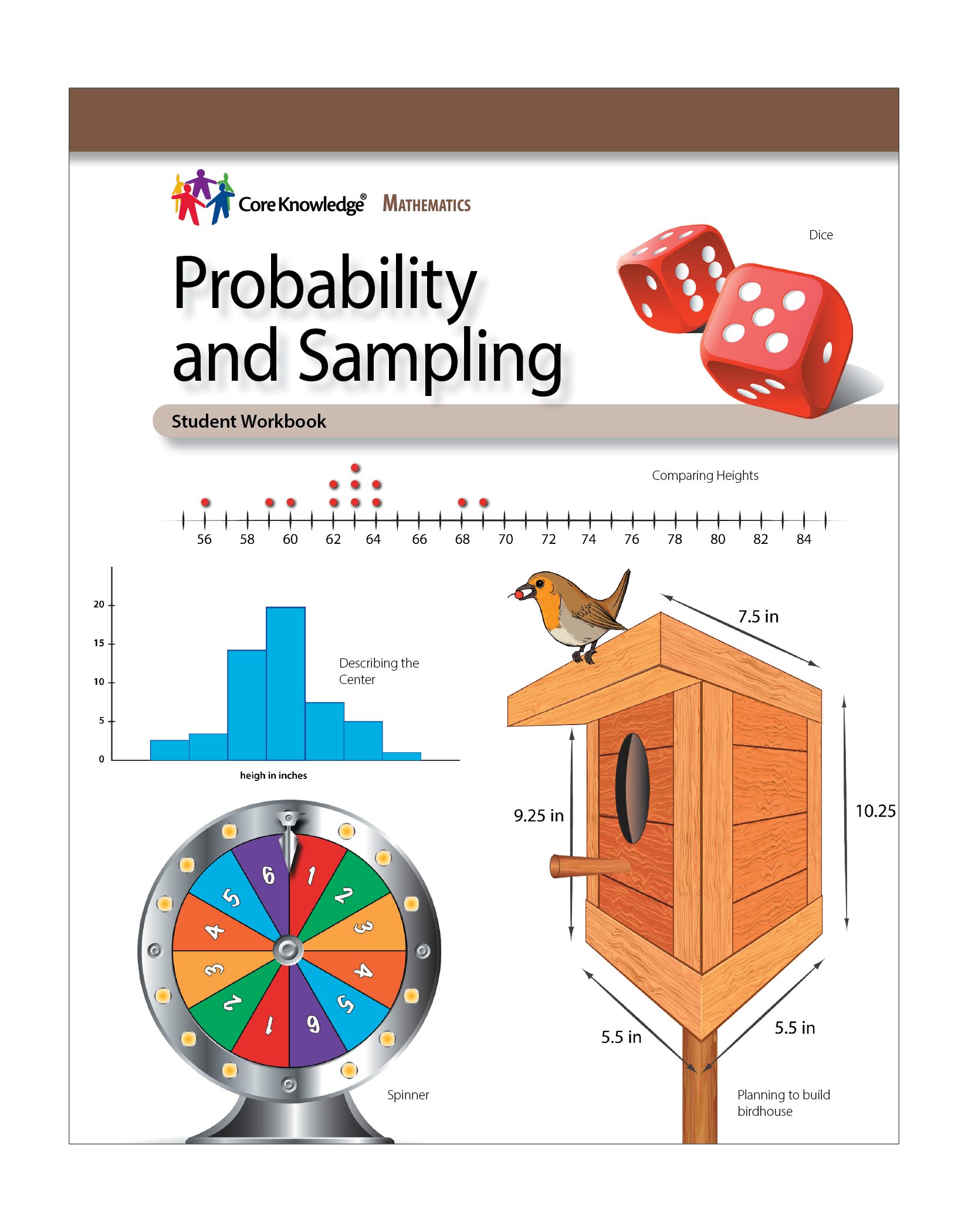
CKMath Unit 8: Probability and Sampling
Focus:
In this unit, students understand and use the terms “event,” “sample space,” “outcome,” “chance experiment,” “probability,” “simulation,” “random,” “sample,” “random sample,” “representative sample,” “overrepresented,” “underrepresented,” “population,” and “proportion.” They design and use simulations to estimate probabilities of outcomes of chance experiments and understand the probability of an outcome as its long-run relative frequency. They represent sample spaces (that is, all possible outcomes of a chance experiment) in tables and tree diagrams and as lists. They calculate the number of outcomes in a given sample space to find the probability of a given event. They consider the strengths and weaknesses of different methods for obtaining a representative sample from a given population. They generate samples from a given population, e.g., by drawing numbered papers from a bag and recording the numbers, and examine the distributions of the samples, comparing these to the distribution of the population. They compare two populations by comparing samples from each population.
Number of Lessons: 18 and 2 optional
Instruction Time:
Approximately 60 minutes
(Please note that each lesson is designed for one instructional block, and may be divided into shorter or longer segments based on teacher pacing and student needs.)