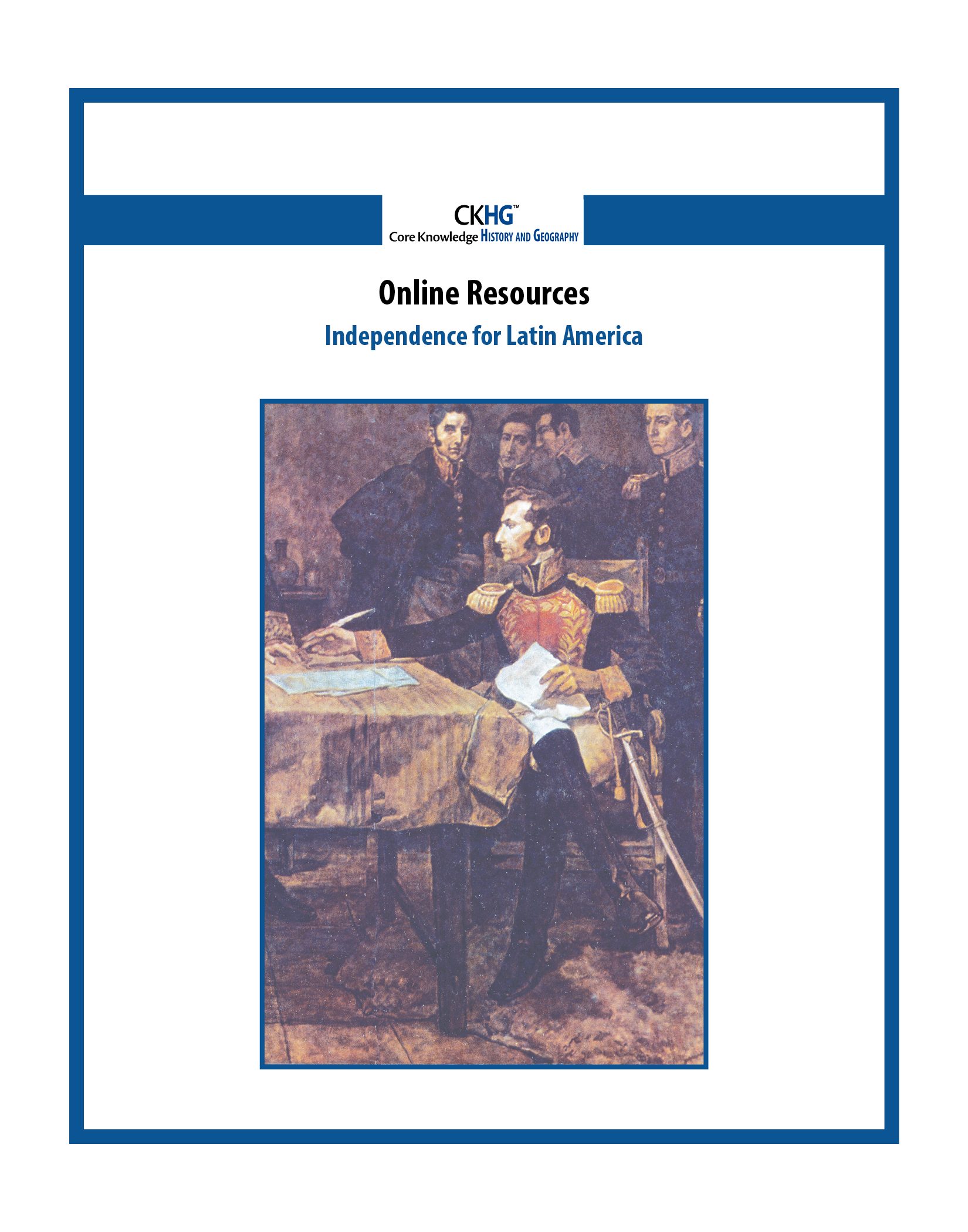
CKHG Unit 6: Independence for Latin America
Focus:
In this unit, students explore the wave of independence movements that led to the liberation of French, Spanish, and Portuguese Latin American colonies beginning in the late 1700s and lasting into the early 1900s. Generally, these colonies had rigid class systems with wealthy landowners controlling large tracts of land with poor workers providing the labor. By 1830, however, most Latin American nations had won their independence from European colonial governments with the help of leaders like Toussaint Louverture in Haiti, Miguel Hidalgo y Costilla in Mexico, Simón Bolívar in Venezuela, and José de San Martín in Argentina. Students also learn that while many of these revolutions brought about new political and personal freedoms, independence proved easier to achieve than political stability. Almost every Latin American country has experienced the same cycle of government control by caudillos (regional strongmen), revolution, civil war, and violence.
Number of Lessons: 7
Instruction Time:
45 minutes (Each lesson may be divided into shorter segments.)
Additional Search Terms:
social studies • nonfiction • informational text • geography • map skills • colonialism • indigenous people • Creoles • mestizos • enslaved people • class system • Saint-Domingue • Hispaniola • Toussaint Louverture • Haitian rebellion • Jean-Jacques Dessalines • Mexico • Querétaro • Miguel Hidalgo y Costilla • Ignacio Allende • José María Morelos • Agustín de Iturbide • General Santa Anna • Benito Juárez • Pancho Villa • Emiliano Zapata • Simón Bolívar • Francisco de Miranda • New Granada • Venezuela • Gran Colombia • Buenos Aires • Río de la Plata • Chile • José de San Martín • Brazil • King João VI • Pedro I