
Beth Anderson 7 min read · May 15, 2026
“AI has the potential to solve the last mile problem of putting learning science into practice.” – Melina Uncapher, SETA-ED
That line, heard at the ASU+GSV Summit last month in San Diego, has stayed with me.
At an event dominated by claims of what AI will do for education, this one stood out because it named a problem in K-12 education that is older than AI itself: the persistent gap between what learning science suggests and what systems reward, markets sell, and classrooms can realistically implement consistently.
But the framing carries a hidden premise. AI doesn’t solve the last mile in the abstract. It encodes a theory of learning and scales it. Which means the question we must ask first is, which theory?
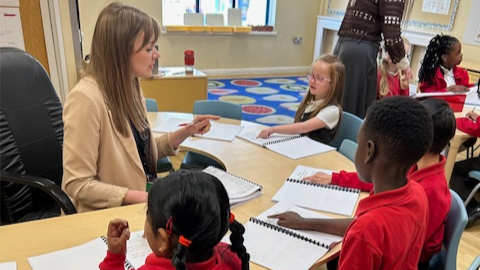
That was the question on my mind as I left San Diego and headed to the United Kingdom to visit schools implementing knowledge-rich curriculum, two of which use Core Knowledge.
These were schools where technology was not the centerpiece. In some classrooms, tech was absent entirely. AI was barely part of the conversation, yet these UK schools answered that question more clearly than any conference panel could.
The “last mile” problem is not new but still unsolved
In K–12 education, there have long been significant gaps between what the science of learning suggests is most likely to produce durable learning and what schools, systems, curriculum publishers, and edtech providers are incentivized to prioritize, develop, adopt, and measure.
Teachers operate within systems that prioritize standards alignment, differentiation, engagement, and test performance. Publishers and edtech companies respond to those same incentives. The result is a marketplace flooded with standards-aligned materials and time-saving tools that may or may not reflect how students actually learn and retain knowledge over time.
A curriculum can be standards-aligned yet still lack coherence, cumulative knowledge-building, explicit sequencing, meaningful retrieval practice, or attention to cognitive load. In many systems, “alignment” has become a proxy for quality, even though alignment alone does not guarantee coherent instruction or durable learning.
A similar tension shapes “personalization.” Meeting students where they are matters, but when personalization fragments the shared knowledge base itself and sends each student down a different path, it can undermine the deep learning it aims to support, especially for students who struggle or start with less prior knowledge.
Yet in pockets across the system, this “last mile” problem is already being addressed — not primarily through software or platforms, but through people, practice, and sustained instructional leadership.
School and system leaders like Gareth Rein in Wales and former Louisiana State Superintendent John White have helped create conditions where coherent curriculum, teacher development, and high expectations reinforce one another.
Educators such as Olivia Mullins, Lauren Brown, Sean Morrissey, and many more are deeply engaging with cognitive science and translating it into daily classroom practice.
Practitioners, advisers, and trainers like Meg Lee and Kristen McQuillan are helping bridge the gap between research and instruction in practical, actionable ways.
At the same time, researchers like Tim Surma and his team in Belgium are partnering directly with schools and systems to demonstrate how coherent, knowledge-rich curriculum and evidence-informed instruction can support strong learning outcomes for students.
These efforts are not theoretical. They are operational. They are happening in real schools with real students.
But they are not yet consistent, sustained, or scaled in ways that make them the norm rather than the exception.
That is the gap Melina Uncapher is pointing to. And it is the gap where AI is now poised to enter. Not as a neutral tool, but as a system that will encode and scale a theory of learning whether we are intentional about which one or not.
Three Schools, Three Contexts, One Clear Pattern
In the United Kingdom, I visited three very different schools:
- St. Peter’s Primary School in Cardiff, Wales
- TASIS England in Surrey, England
- Michaela Community School in Wembley, England
Different student populations. Different models. Different leadership styles. Different cultures.
And yet the pattern across them was strikingly consistent.
What stood out was not just performance data or inspection outcomes, though all three perform strongly by relevant measures.
It was the students.
Students who engage actively and speak with clarity, curiosity, and confidence.
Students who take visible pride in what they know.

At St. Peter’s, one parent described the impact of leadership change in a way that has stayed with me:
“It has raised both the floor and the ceiling for all students.”
That is not a slogan. It is a description of what happens when expectations, curriculum, and teaching quality align.
Across all three schools, two things were consistently present:
- Leadership with clarity and conviction
Strong leadership is not just managerial. It is cultural.
It sets direction, aligns adults, makes expectations explicit, and creates consistency across classrooms.
In these schools, the curriculum, pedagogy, teacher training, classroom routines, and leadership language all reinforced one another. There was coherence between what students were learning, how teachers were teaching, and what each school valued and supported.
- A knowledge-building curriculum, taught with precision
When curriculum is structured, sequenced, and intentionally knowledge-rich, and when teachers are supported in delivering it well, the effects are visible:
Students don’t just accumulate information. They build understanding.
And more importantly, they develop expectations about themselves:
- “I can actually understand this.”
- “I can explain this.”
- “I am expected to know this.”
That shift in expectation is one of the most powerful, and least discussed, drivers of educational equity.
Because once students begin to expect success, to see themselves as capable of understanding demanding content, the ceiling changes.
Not just for the highest attainers, but across the entire distribution.

The Instructional Architecture Underneath
If AI is going to encode a theory of learning, the question is which theory. The educators and leaders walking the last mile are drawing on a body of work that has been remarkably aligned for decades.
St. Peter’s head Gareth Rein jokingly calls it the “Four D’s”– four thinkers whose work has shaped much of the knowledge-rich curriculum movement, and where he often directs educators beginning to explore the connection between curriculum, instruction, and learning science.
Don (E.D. Hirsch, Founder of Core Knowledge) has spent decades arguing that coherent shared knowledge is foundational to literacy, equity, and democratic participation. From Cultural Literacy to Why Knowledge Matters, his work reframed knowledge and curriculum as a matter of justice, not preference.
Daniel Willingham has helped translate cognitive science into practical insights for educators. His core message is deceptively simple: thinking depends on knowledge. Memory is not a flaw in learning; it is the mechanism that enables it. Without prior knowledge stored in memory, new learning becomes dramatically harder, because new ideas connect to existing ones in the brain.
Daisy Christodoulou, a former teacher turned author and edtech leader, has been an influential voice in challenging misconceptions about assessment, skills, and “learning styles,” particularly in the UK context. Her work consistently returns to a central idea: we often overestimate the value of generic skills and underestimate the role of domain knowledge.
Doug Lemov brings something different but essential: a relentless focus on teacher practice. Through thousands of classroom observations, his work examines what effective teaching looks like in practice, down to the routines, questions, and techniques that shape learning moment by moment.
This is not a fringe or random collection. It is a coherent, decades-old body of work about how humans learn, what curriculum should do, and what teaching looks like when it respects both. It is the foundation underneath what I saw in Cardiff, Surrey, and Wembley. And it is the underlying architecture AI would need to encode if it is going to amplify the last mile rather than route around it.
Where This Leaves Us
The excitement around AI in education is real. So is the risk of overestimating what it can do in isolation.
What feels more grounded, and more urgent, is this:
The biggest constraint in education is not access to tools or information.
It is the consistent implementation of what we already know about how learning works.
Learning science is not new. Knowledge-rich curriculum is not new. Cognitive psychology is not new.
The challenge has always been the same: getting it into every classroom, every day, for every student.
If AI has a role worth paying attention to, it is not in replacing that work, but in helping close the gap between knowing and doing.
So can AI help bridge the divide between what learning science suggests and what classrooms can realistically implement at scale?
Or will AI simply amplify the incentives already driving the system — optimizing for engagement, speed, and hyper-personalized experiences rather than coherence, shared knowledge, memory, and long-term learning?
AI will not eliminate theories of learning. It will encode and scale one.
Used well, AI could ease one of education’s greatest challenges: the translation burden between research and practice. It could support curriculum coherence (Hirsch), retrieval practice (Willingham), assessment that measures durable knowledge rather than generic skill (Christodoulou), and feedback on teacher practice (Lemov) — while allowing teachers to focus more deeply on relationships, instruction, and student thinking.
Most concretely, an AI built on this foundation would build knowledge cumulatively across a shared curriculum, with personalization layered on top rather than as a substitute for it. And it would know when to stop helping — letting students work through productive difficulty rather than smoothing every friction point in the name of engagement. Those two design choices would distinguish it from much of the edtech on the market today.
The question is whether we will be intentional enough about the instructional architecture underneath AI before it scales and accelerates the system we already have.
That “last mile” is still the frontier.