CKMath Unit 5: Arithmetic in Base Ten
Focus:
In this unit, students learn an efficient algorithm for division and extend their use of other base-ten algorithms to decimals of arbitrary length. Because these algorithms rely on the structure of the base-ten system, students build on the understanding of place value and the properties of operations developed during earlier grades. The unit begins with a lesson that revisits sums and differences of decimals to hundredths, and products of a decimal and whole number. The tasks are set in the context of shopping and budgeting, allowing students to be reminded of appropriate magnitudes for results of calculations with decimals.
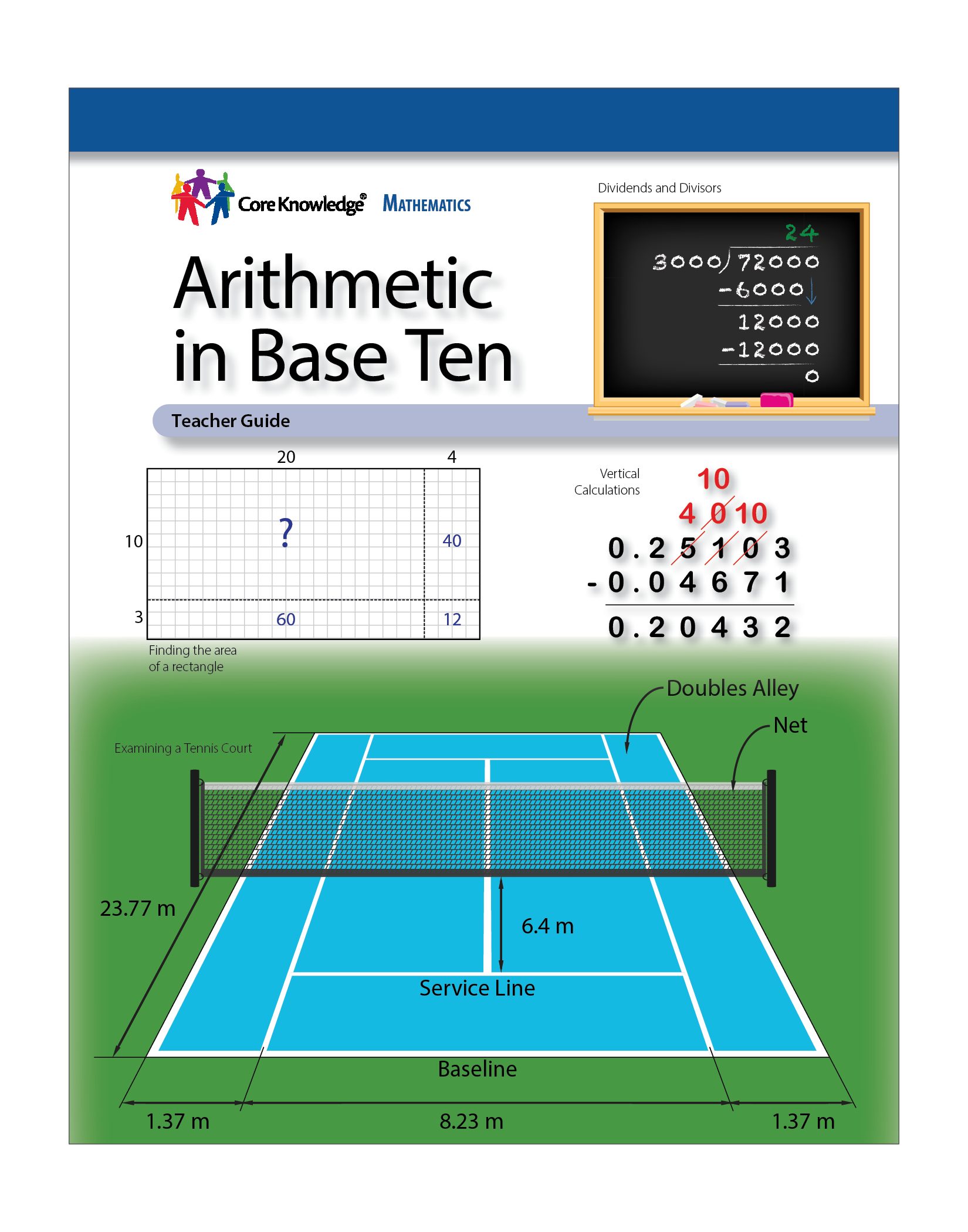
The next section focuses on extending algorithms for addition, subtraction, and multiplication, which students used with whole numbers in earlier grades, to decimals of arbitrary length. Students begin by using “base-ten diagrams,” diagrams analogous to base-ten blocks for ones, tens, and hundreds. These diagrams are designed so that the area of a figure that represents a base-ten unit is one tenth of the area of the figure that represents the base-ten unit of next highest value. Thus, a group of 10 figures that represent 10 like base-ten units can be replaced by a figure whose area is the sum of the areas of the 10 figures. Students first calculate sums of two decimals by representing each number as a base-ten diagram, combining representations of like base-ten units and replacing representations of 10 like units by a representation of the unit of next highest value, e.g., 10 rectangles compose 1 large square. Next, they examine “vertical calculations,” representations of calculations with symbols that show one summand above the other, with the sum written below. They check each vertical calculation by representing it with base-ten diagrams. This is followed by a similar lesson on subtraction of decimals. The section concludes with a lesson designed to illustrate efficient algorithms and their advantages, and to promote their use.
The third section, multiplication of decimals, begins by asking students to estimate products of a whole number and a decimal, allowing students to be reminded of appropriate magnitudes for results of calculations with decimals. In this section, students extend their use of efficient algorithms for multiplication from whole numbers to decimals. They begin by writing products of decimals as products of fractions, calculating the product of the fractions, then writing the product as a decimal. They discuss the effect of multiplying by powers of 0.1, noting that multiplying by 0.1 has the same effect as dividing by 10. Students use area diagrams to represent products of decimals. The efficient multiplication algorithms are introduced and students use them, initially supported by area diagrams.
In the fourth section, students learn long division. They begin with quotients of whole numbers, first representing these quotients with base-ten diagrams, then proceeding to efficient algorithms, initially supporting their use with base-ten diagrams. Students then tackle quotients of whole numbers that result in decimals, quotients of decimals and whole numbers, and finally quotients of decimals.
The unit ends with two lessons in which students use calculations with decimals to solve problems set in real-world contexts. These require students to interpret diagrams, and to interpret results of calculations in the contexts from which they arose. The second lesson draws on work with geometry and ratios from previous units. Students fold papers of different sizes to make origami boxes of different dimensions, then compare the lengths, widths, heights, and surface areas of the boxes.
Number of Lessons: 13 and 2 optional
Instruction Time:
Approximately 50 minutes
(Please note that each lesson is designed for one instructional block, and may be divided into shorter or longer segments based on teacher pacing and student needs.)