CKHG Unit 9: Reform in Industrial America
NOTE: The resources for this unit are in the third part of The Making of America: Immigration, Industrialization, and Reform.
Focus:
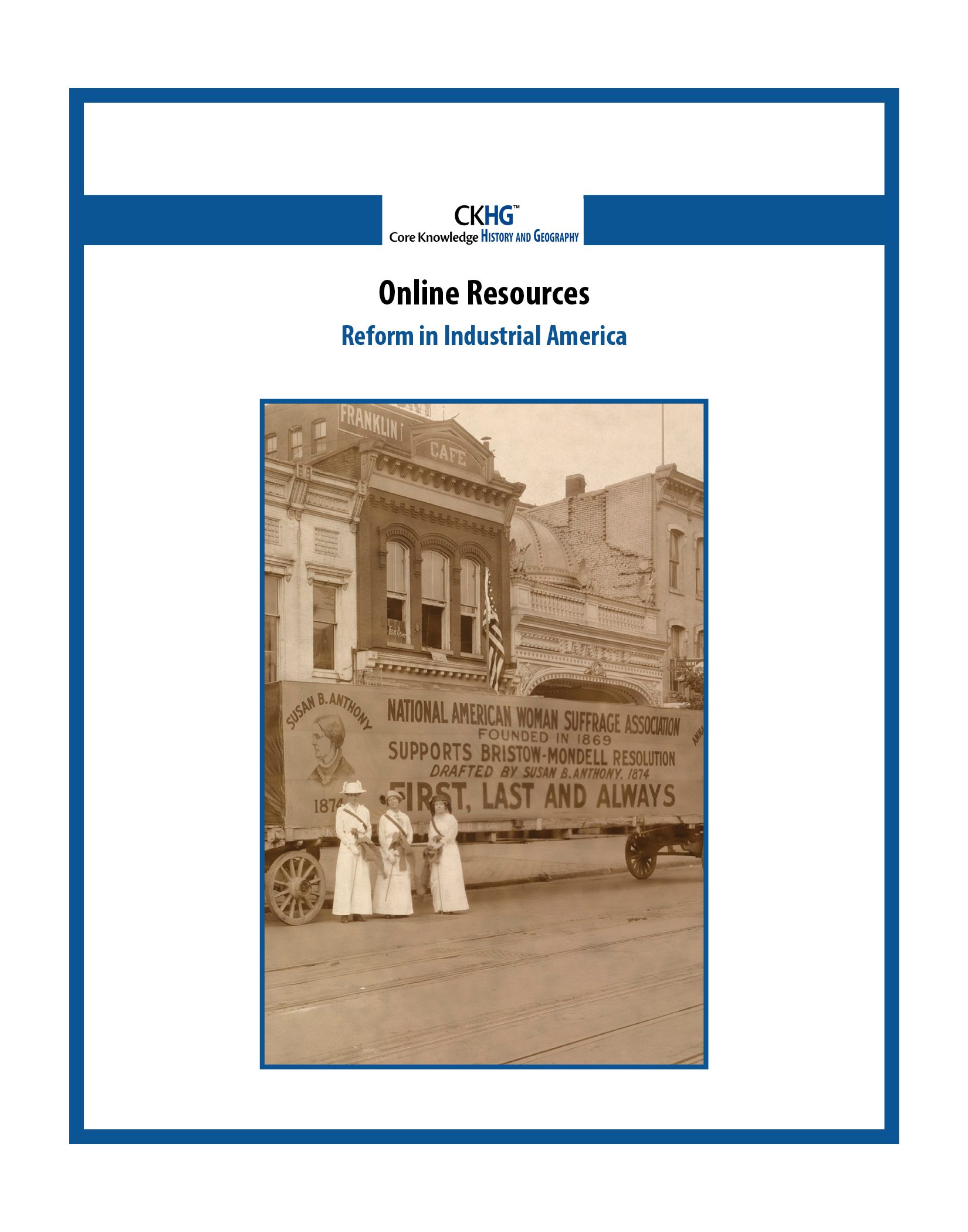
In this unit, students examine the groups and individuals who worked for political, economic, and social reform in America in the late 1800s and early 1900s.
This period was a time of extremes and inequities in America, with railroad tycoons and oil magnates living in cities populated by impoverished immigrant factory workers. Many farmers were struggling to survive. African Americans lived under Jim Crow laws that took away their civil rights, and women were still not allowed to vote. Students also learn that populist farmers, muckrakers, urban reformers, suffragettes, civil rights leaders, and social reformers worked to ease the credit crunch, expose the excesses of big business, improve tenement housing, obtain equal rights for African Americans and for women, and improve the lives of workers. President Theodore Roosevelt pushed for conservation measures, and Americans showed they could work together to improve the lives of ordinary citizens.
Number of Lessons: 7
Instruction Time:
45 minutes (Each lesson may be divided into shorter segments.)
Additional Search Terms:
social studies • nonfiction • informational text • geography • map skills • Populism • free silver • William Jennings Bryan • muckrakers • Ida Tarbell • John D. Rockefeller • Sherman Antitrust Act • trusts • Upton Sinclair • Jane Addams • Hull House • Jacob Riis • tenements • Theodore Roosevelt • conservation • national parks • Fourteenth Amendment • Jim Crow laws • “separate but equal” • civil rights • Ida B. Wells • lynching • Booker T. Washington • Tuskegee Institute • W.E.B. Du Bois • The Souls of Black Folk • National Association for the Advancement of Colored People (NAACP) • women’s suffrage • Susan B. Anthony • Nineteenth Amendment • Eugene Debs • socialism • Pullman Strike